

Security Access Doors
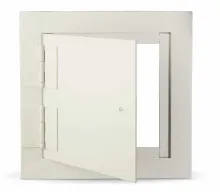
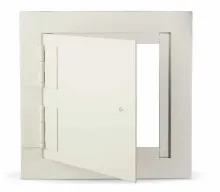
Why a service opening weakens a secure wall
A service opening in a secure area is a weak point in the wall unless the door is built to the same standard as the wall. Karp builds two grades for this, and the choice between them comes down to who is on the other side of the panel.
Medium and high security grades compared
The DSB-123SD-MS is the medium security grade, for areas that need tamper resistance without full high security construction. Read both spec sheets against the project's security requirement, because the difference between the grades is in the construction rather than the appearance.
The DSB-123SD is the high security grade. Karp specifies it as enabling architects and institutions to bring maximum security to areas where access is required for repair or maintenance purposes, which in practice means any location where the panel itself could be attacked or dismantled. Standard sizes are 12 x 12, 16 x 16, 18 x 18, 24 x 24, 36 x 24 and 36 x 36 inches, with shipping weights from 35 pounds at 12 x 12 up to 115 pounds at 36 x 36. Those weights are the clearest single indicator of how much steel is in the door: a standard 36 x 36 access door is a fraction of that.
Hardware, anchoring and door weight
Three points to settle.
- Hardware, because the lock is the door's weakest element. Detention locks and tamper-resistant spanner and allen head fixings are available across the Karp range, and the specification should name the lock rather than leaving it to supply.
- Anchoring, because a reinforced door in an under-anchored frame can be removed as an assembly. Confirm the anchoring detail against the wall construction.
- Weight, because a 115 pound door needs the opening framed for it and two people to hang it.
For behavioral health areas where ligature risk is the governing concern rather than forced entry, see the KAL anti-ligature door in the specialty category.