

Exterior Access Doors

What makes a door suitable for outdoor walls and soffits
An exterior access door has a harder job than an interior one. It sits in the building envelope, which means it has to keep weather out, hold the thermal line and not corrode after a few winters. A standard interior door used outside will leak air at the frame and rust at the fixings.
The MX and the MXPL compared
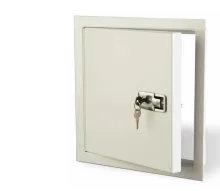
The MX is the flush exterior door. It is built with 2X insulation, factory applied caulking and a rust resistant design, and Karp describes it as improving acoustical and thermal performance while significantly reducing air leaks and water penetration. Factory caulking matters on site: the seal is applied under controlled conditions rather than by whoever is standing on the scaffold at the time. Standard sizes run 12 x 12, 18 x 18, 24 x 24, 30 x 22, 30 x 30, 36 x 24 and 36 x 36.
The MXPL is the same application with a plaster and stucco flange, for exterior walls and soffits finished in stucco. The flange keys into the coat so the door finishes level with the render rather than sitting on top of it.
Insulation, finish and orientation in the building envelope
Three things to settle before ordering. Orientation, because a soffit door and a wall door handle water differently and the soffit case needs the seal to work upside down. Finish, because exterior exposure is where material choice pays for itself - Type 304 stainless is available across the Karp range for weathering locations. And insulation continuity, because a door in an insulated wall is a hole in the insulation unless the door itself is insulated, which is what the 2X insulation on the MX is for.
Made in the USA, with standard sizes on a 72 hour turnaround.