

Sound Resistant
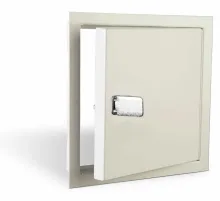
Why an access panel is the weak point in an acoustic wall
Sound follows the path of least resistance, and an ordinary access panel in an acoustically rated wall is exactly that. A hollow steel door with no gasket transmits and leaks around its perimeter, which is why a mechanical room next to a hotel guest room can pass on paper and fail once it is occupied.
Inside the STC acoustical access door
Karp builds one model for this application. The STC acoustical door is a galvanized steel access door fabricated with 5/8 inch acoustical tile, which is what gives the panel mass and absorption rather than leaving it hollow. The perimeter is sealed with 3/8 by 1/8 inch closed cell neoprene gasketing, because a door with an absorptive core and an unsealed perimeter still leaks at the frame.
Standard sizes are 12 x 12, 18 x 18 and 24 x 24 inches.
Typical applications are recording and broadcast studios, mechanical and plant rooms, hotels, hospitals and any partition between an occupied space and a noise source where the access opening would otherwise be the weak point.
STC against NRC, and why the gasket matters
Two things worth understanding before it goes on a drawing.
STC and NRC measure different things and are not interchangeable. STC describes how much sound the assembly stops passing through it. NRC describes how much sound the surface absorbs rather than reflecting back into the room. A door can perform on one and not the other, so read which figure the specification is asking for.
And the gasket is not optional detail. Compression against a true frame is what closes the perimeter path. An out-of-square opening or a frame distorted during installation will cost more performance than any change of core material will recover.
For acoustic performance data on a specific size, download the spec sheet or contact the sales team.