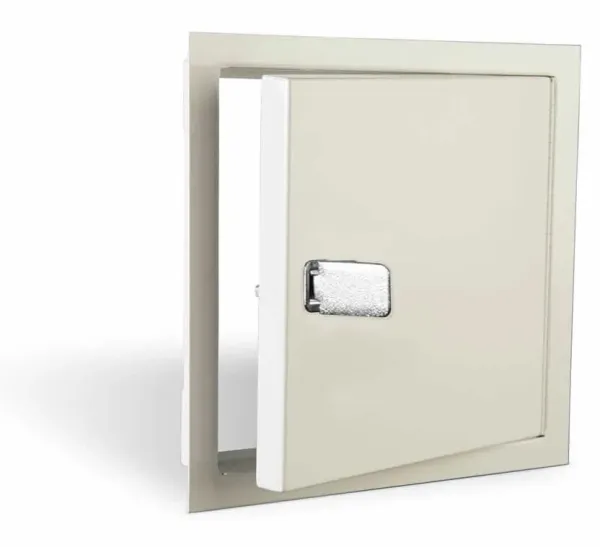
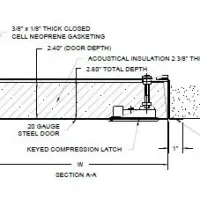
The Karp STC acoustical access door is designed for wall and ceiling openings where sound control is part of the project requirement. The door uses a 20 gauge steel panel, 2 3/8 inches of acoustical insulation and a full-perimeter closed-cell neoprene gasket. A keyed lift-and-turn compression latch draws the panel tightly against the gasket to control sound transmission around the perimeter.
The STC is independently tested to ASTM E1332, ASTM E90 and ASTM E413 and rated STC 64.
Why an acoustical access door matters
An access panel can become a weak point in an acoustically controlled wall. Even when the surrounding wall has been designed for sound isolation, an unsealed access opening can provide a path for sound transmission.
The STC addresses that opening with three important elements: an insulated door panel, a continuous perimeter gasket and a compression latch that pulls the panel tightly against the seal.
The result is an access door designed to maintain sound isolation where the wall assembly requires acoustic performance.
How the STC controls sound
The STC uses 2 3/8 inches of acoustical insulation inside the door. The full-perimeter neoprene gasket then seals the joint between the door and frame.
The keyed lift-and-turn compression latch is important because the gasket needs compression to seal effectively. Simply closing an access panel does not provide the same result as drawing the panel firmly against a continuous perimeter gasket.
The assembly also uses a continuous piano hinge and a one-piece 1 inch wide trim.
Where to use an acoustical access door
The STC is intended for applications where access to building services is required without creating an unnecessary weak point in an acoustically controlled wall or ceiling.
Karp identifies applications including:
- Recording studios
- Broadcast suites
- Rehearsal rooms
- Mechanical and plant rooms adjoining occupied spaces
- Hotel corridors and guest room demising walls
- Hospitals and consulting rooms
- Classrooms and lecture theatres
- Examination rooms
- Tenant demising walls
The appropriate application depends on the acoustic requirements of the complete wall or ceiling assembly.
For other access-door requirements, see Karp's sound-resistant access doors and standard access doors.
STC 64 rating
The STC acoustical access door is independently tested and rated STC 64. STC, or Sound Transmission Class, is used to describe how well a building assembly reduces airborne sound transmission.
STC is different from NRC. NRC describes sound absorption by a surface, while STC relates to sound transmission through an assembly. For an access door installed in a demising wall or other sound-controlled partition, STC is the relevant performance measure.
Choosing the right access door size
The STC is available in standard sizes of 12 x 12, 18 x 18 and 24 x 24 inches, with special sizes available on request.
The wall opening is 3/8 inch larger than the door size in each direction. A 24 x 24 inch door therefore requires a 24 3/8 x 24 3/8 inch opening.
The overall trim dimension is also larger than the nominal door size, so allow sufficient finished-wall clearance when planning the installation.
Select the smallest opening that provides the access required for the equipment behind the panel. A smaller access door minimizes the area of the wall that needs to be interrupted while still providing practical service access.
For help evaluating access door dimensions, see Karp's guide to access panel sizes and selecting the right size.
Construction and finish
The STC uses a 16 gauge steel frame and 20 gauge steel door with 2 3/8 inches of acoustical insulation. The standard finish includes a rust-inhibitive electrostatic powder prime coat with baked white enamel.
A stainless steel version with a No. 4 finish is also available.
The product is independently tested to ASTM E1332, ASTM E90 and ASTM E413.
Karp also provides architectural specifications for architects, engineers, contractors and other project specifiers.