

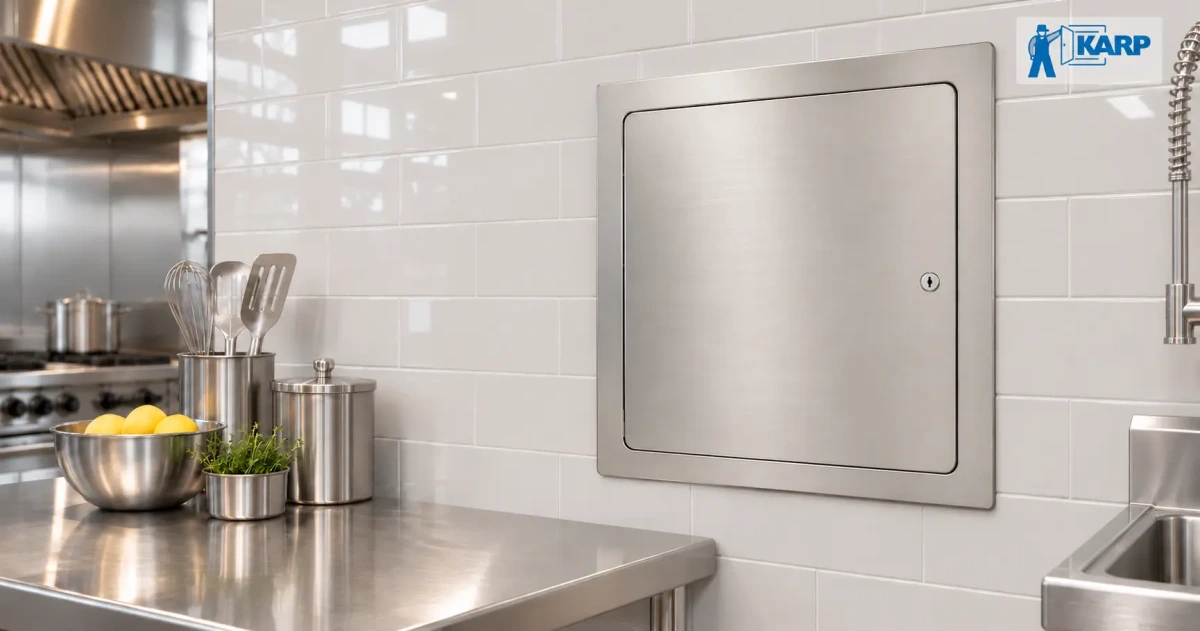
Type 304 stainless vs painted steel access panels: where each belongs, the No. 4 finish, bleach and pool risks, and which Karp models come in stainless.
A stainless steel access panel costs more than a painted steel one, and on most jobs nobody can tell you why the spec calls for it beyond "it's a kitchen." That is the wrong way round. Stainless earns its price in a small number of locations where a painted door will rust, flake or fail an inspection, and it wastes money in the many locations where a painted door will last as long as the wall it sits in.
This guide covers what a stainless steel access panel should actually be on a specification, how Type 304 differs from painted steel in use, where each one belongs, the cleaning detail that damages more stainless doors than salt ever does, and which Karp models are offered in stainless. If you are still choosing a size, start with our guide to access panel sizes and opening dimensions and come back for the material.
What "stainless steel access panel" should mean on a specification
The phrase covers a wide range of products. Some are solid stainless door and frame. Some are painted steel with a stainless trim or hinge. Some are listed as "stainless" in a product title while the data sheet says powder coated steel. If the specification just says "stainless access panel," any of these can turn up on site.
Write three things instead:
- The grade. Type 304 is the standard austenitic grade used for architectural and hygienic products. Name it.
- The finish. Karp's stainless doors carry a No. 4 satin finish, which Karp describes as a general purpose bright finish with a visible grain that prevents mirror reflection. The grain matters for cleaning, which is covered below.
- What is stainless. Door and frame, at minimum. Then ask about the hardware: hinge, latch body, cam and fasteners. A stainless door hung on a plated steel hinge will show rust at the hinge first.
On Karp product pages, the material option reads the same way across the range: Type 304 stainless steel is described as suited to exterior weathering locations and to interior hygienic locations such as hospitals and health care, pharmaceutical plants, research laboratories and food processing facilities. Those two groups are the whole case for stainless, and the rest of this guide follows them.
Type 304 vs painted steel: what actually differs
Both are steel. The difference is where the corrosion protection lives. On painted steel it is a coating on the surface. On stainless it is the chromium in the metal itself, which forms a thin passive film that reforms when the surface is scratched, provided oxygen can reach it and the surface is kept clean.
| Factor | Painted steel | Type 304 stainless, No. 4 satin |
|---|---|---|
| Corrosion protection | Coating over carbon steel | Chromium oxide film in the metal |
| Scratch, chip or cut edge | Bare steel exposed, rust starts there | Film reforms; no coating to lose |
| Can be painted to match the wall | Yes, that is the point of the primer | Usually left bare; painting it wastes the material |
| Daily wipe-down and sanitizer | Coating wears at edges and latch | Suited to it, with a rinse (see below) |
| Look | Disappears into a painted wall | Reads as metal; matches stainless fixtures |
| Cost | Lower | Higher |
| Where it fits | Dry interior walls and ceilings | Wet, washdown, hygienic and weather exposed areas |
Why painted steel fails where it fails
A painted access door rarely rusts across its face. It rusts at the places where the coating takes damage: the latch hole, the hinge line, the door edge that gets pried with a screwdriver, and the bottom of the frame where cleaning water collects. Karp's painted doors use proper factory finishes. The KAWT air and water tight door, for example, is 16 gauge steel with a 5 stage iron phosphate coating and a white baked, paintable enamel. A good finish delays the problem. It cannot stop a scraped edge from rusting in a room that is wet every day.
What the No. 4 satin finish does
No. 4 is a brushed finish with a directional grain. It hides fine scratches and fingerprints better than a mirror finish and does not throw glare under kitchen or clinic lighting. It also has a direction: clean along the grain, not across it or in circles, or the door will look smeared next to the stainless equipment around it.
Where a stainless steel access panel belongs
Use stainless where at least one of these is true: the surface is washed or sanitized routinely, the room is wet or humid most of the time, the door is outdoors or in a weather exposed soffit, or the space is inspected for hygiene.
- Commercial kitchens. Walls behind cooklines, dish areas and walk-in prep zones get grease, steam and daily cleaning chemicals. A stainless door matches the equipment and survives the cleaning schedule.
- Healthcare. Soiled utility rooms, sterile processing, clinic restrooms and any wall that infection control staff wipe with disinfectant on a schedule.
- Pharmaceutical plants and laboratories. Where surfaces are wiped with aggressive agents and corrosion debris is unacceptable.
- Food processing. Washdown walls and ceilings where water, cleaning foam and sanitizer reach every surface.
- Tiled wet areas. Public restrooms, locker rooms and showers. Here the right answer is often a stainless frame with tile in the door: the DSC-210 recessed door for tile takes tile up to 1 inch thick in the panel, so the grout lines carry across the door.
- Exterior walls and soffits. Weather exposure is the second half of Karp's stainless guidance. For sealing and insulation, which matter more than the metal outdoors, see our guide to exterior access doors.
Where painted steel is the right call
Most access panels on most buildings should be painted steel, and specifying stainless everywhere "to be safe" is a common way to blow a Division 08 budget.
- Dry interior walls and ceilings. Offices, corridors, classrooms, retail back of house and plant rooms. Nothing there attacks a primed and painted door.
- Doors that should disappear. A painted door takes the wall color. A stainless door in a painted corridor wall reads as a metal plate, which is the opposite of what most architects want. If the goal is to hide the opening, look at concealed access panels rather than either metal.
- Drywall partitions in standard rooms. The standard access door range covers these, and the install is the same whichever metal you choose. Our drywall installation guide walks through it.
- Security and heavy-gauge doors in dry rooms. Karp's DSB-123SD high security door is 10 gauge steel with a rust-inhibitive electrostatic powder primer and baked enamel. Its strength comes from the gauge and the welded frame, not the metal type.
One middle case: a back-of-house corridor next to a kitchen that gets mopped but not hosed. A painted door is usually fine if the bottom frame edge sits above the mop line. If it sits low and the floor is wet-cleaned daily, stainless pays for itself.
Bleach, not salt: the cleaning detail most specs miss
Most people think of salt as the threat to stainless steel. In a commercial kitchen or clinic, the bigger risk is the sanitizer bucket. The Australian Stainless Steel Development Association explains the distinction in its note on chlorine versus chloride and stainless steel: chloride is the salt in ordinary water, and chlorine is bleach.
The figures it gives, from Nickel Institute guidance for continuous exposure at room temperature and neutral pH, make the point. Type 304 tolerates around 200 ppm of chloride but only about 2 ppm of chlorine. Bleach-based sanitizers are mixed at many times that. Stainless survives them because the contact is short, and ASSDA notes that the food industry uses strong chlorine solutions for minutes, followed by rinsing. The damage comes when the solution stays on the metal.
On an access panel, that happens in three places:
- The bottom edge of the frame, where wipe-down solution runs and dries.
- The gap between door and frame, where a spray of sanitizer is never rinsed out.
- Around the latch, where solution sits in the recess.
Put "rinse with clean water after chlorine-based sanitizer" in the operations and maintenance notes for any stainless door in a food or clinical area. It costs nothing and it is the single biggest factor in whether a 304 door still looks right in ten years. Avoid steel wool and carbon steel brushes for the same reason: they leave iron particles in the surface that rust and stain the door, and the stain gets blamed on the stainless.
When Type 304 is not enough
Type 304 is the right grade for the vast majority of interior hygienic and exterior locations. Three situations need a closer look before you specify it.
Coastal and de-icing salt exposure
Doors within reach of sea spray, or at grade where road salt splashes, sit in much higher chloride levels than ordinary rain. 304 can tea-stain there if it is never washed. Tell the sales team the exposure when you request a quote, and plan for rain-washed or routinely rinsed locations where you can.
Ceilings over indoor chlorinated pools
This is the one environment where stainless steel has failed structurally. ASSDA's technical note on stainless steel in indoor swimming pool buildings describes 304 and 316 rods, wires and bolts under tension cracking in high, unwashed areas above warm chlorinated pools. The same note says doors and other components that are washed and not under tensile stress have not shown the problem. For an access panel in a natatorium ceiling, the door itself is the low risk part. The safety chains, hanger wires and fixings holding it up are the high risk parts, and they are exactly what nobody washes. Raise them with the design team and the sales team before ordering.
Aggressive process chemistry
Labs and plants that use strong acids or high-chloride process fluids near the wall may need a higher grade than 304. Karp publishes Type 304 as its stainless option. If your specification calls for another grade, send it to the sales team before writing it into the documents.
Which Karp models come in stainless steel
The Type 304, No. 4 satin option is listed on the product pages below. Sizes and openings are taken from each model's published table.
| Model | What it is | Standard sizes | Opening | Best stainless use |
|---|---|---|---|---|
| DSC-214M | Flush door for all surfaces, exposed flange | 24 sizes, 6 x 6 to 48 x 24 | Door + 3/8 in | Kitchen and clinic walls and ceilings |
| DSC-210 | Recessed door for tile up to 1 in | 12 x 12 to 36 x 24 (5 sizes) | Door + 1/8 in | Tiled restrooms, showers, kitchens |
| KRP-150FR | Insulated fire rated door, walls and ceilings | 18 sizes, 8 x 8 to 48 x 48 | Door + 3/8 in | Rated walls in hygienic areas (confirm listing) |
| DSB-214SM | Surface mounted, no framing needed | 8 x 8 to 24 x 24 (4 sizes) | No opening table | Retrofits on finished tile or block |
| DSC-214PL | Flush door for plaster, casing bead and lath | 16 sizes, 8 x 8 to 36 x 36 | Door + 3/8 in | Plastered walls in wet or exterior areas |
| STC acoustical | Gasketed, insulated, rated STC 64 | 12 x 12, 18 x 18, 24 x 24 | Door + 3/8 in | Quiet rooms that are also washed down |
The DSC-214M is the usual starting point. It is the most configurable model in the range, with nine latch options, and spanner head or allen head latches suit public restrooms where a tamper-resistant fixing is wanted. For plastered walls, the plaster access door range states that Type 304 is available where the location is hygienic or weather exposed. For tiled walls, the tile access door range pairs the stainless frame with the tile face.
Stainless steel in fire rated walls
A stainless fire rated door is available on the KRP-150FR page, but the rating belongs to the listed construction. Before you specify stainless in a rated wall or ceiling, confirm with the sales team that the listing covers the stainless version at the size and location you need. Our guide to fire rated access door requirements explains what a listing covers and what voids it, and the full fire rated range shows the four models.
Floor doors and stainless hardware
On floor doors the stainless question is about the hardware rather than the plate. The KFD-HD heavy duty floor door uses stainless steel hinges, offers stainless steel compression springs and a stainless snap lock, and can be made watertight for washdown floors. The floor door guide covers load ratings and sizes.
Installing a stainless access panel without ruining it
Stainless is installed the same way as painted steel: frame to the opening in the size table, fix to framing or with masonry straps, then finish the wall. The differences are all about contamination.
- Keep the protective film on until the trades around it are finished. Tile cutting, grinding and welding sparks embed iron in the surface.
- Use stainless fasteners. A zinc plated screw through a stainless flange rusts and stains the frame within months in a wet room.
- Keep carbon steel tools off the face. No steel wool, no carbon steel wire brushes, no grinding discs that have been used on mild steel.
- Clean grout and mortar off promptly with water and a non-scratch pad, along the grain. Do not use acid tile cleaners on the frame unless the product label allows it on stainless.
- Seal the frame to the wall in wet areas so water cannot run behind the flange and sit against the wall framing.
- Hand over a cleaning note: neutral cleaner, wipe along the grain, rinse after any chlorine-based sanitizer.
Product-specific install guidance, spec sheets and CAD drawings are on each product page and in the support section.
Common mistakes with stainless steel access panels
- Writing "stainless" without "Type 304, No. 4." It leaves the door open to stainless-look or part-stainless substitutes.
- Stainless door, plated hardware. The hinge and fasteners rust first and the whole door looks failed.
- Painting a stainless door to match the wall. If it needs to be painted, it should have been painted steel.
- Specifying stainless in every room. It adds cost in dry rooms where a painted door lasts just as long.
- Bleach left to dry on the frame. The most common cause of pitting on interior stainless.
- Assuming the fire listing follows the metal. Confirm the stainless version is covered before specifying it in a rated assembly.
- Ignoring the hangers above a pool. The door is rarely the problem. The unwashed fixings holding it are.
How to specify a stainless steel access panel
- Confirm the location needs it: washdown, hygienic, wet, or weather exposed. If not, specify painted steel.
- Choose the model by surface: DSC-214M for flush walls and ceilings, DSC-210 for tile, DSC-214PL for plaster, KRP-150FR where a fire rating is required.
- Write the grade and finish: Type 304 stainless steel, No. 4 satin finish, door and frame.
- Confirm the hinge, latch and fasteners are stainless or otherwise corrosion resistant.
- Choose the latch for the users: keyed, spanner head or allen head for public areas, knob turn where staff need tool-free access.
- Take the wall or ceiling opening dimension from the size table, not the nominal door size.
- In a rated wall, confirm the listing covers the stainless version at that size.
- Flag unusual exposure (coastal, pool ceilings, process chemicals) to the sales team before the drawings are issued.
- Add the cleaning and rinse note to the O&M manual.
Specification text for every model is in Karp's architectural specifications library, and the full product range is under access doors. Karp doors are made in the USA and standard sizes ship on a 72 hour turnaround. For pricing and availability, add the model to your quote list and Karp will connect you with the nearest authorized distributor.
Frequently Asked Questions
What is a stainless steel access panel?
What is the difference between 304 stainless steel and painted steel access panels?
Where should I use a stainless steel access panel?
Is 304 stainless steel good enough for a commercial kitchen?
When do I need something better than 304 stainless?
Which Karp access doors are available in stainless steel?
Can I get a fire rated stainless steel access door?
How do I clean a stainless steel access panel?

Karp Team
Karp Associates has manufactured access doors, floor doors and roof hatches in the United States since the 1960s, across fourteen product families. All products are made at the company's facility in Melville, New York.
Need the Right Access Solution?
Explore Karp's USA-manufactured access doors, fire-rated panels, and custom solutions built for commercial projects.